Flat Preloader Icon LOADING....

MFathan

Categories
Project Diniyah

Story Telling – The Battle Of Badr

Story Telling About The Battle Of Badr

So, in this project, I’m working on my assignment, which is to tell about the Battle of Badr. So, the Battle of Badr was a war that took place in the second year of the Prophethood, on the 17th of Ramadan. This war took place after the Prophet Muhammad migrated to Medina.

Categories
Project Diniyah

Story telling about prophet muahmmad – diniyah

The story of the birth and childhood of Prophet Muhammad.

The story of the birth and childhood of Prophet Muhammad.

Prophet Muhammad ﷺ was born in Mecca on the 12th day of Rabi’ al-Awwal, in the Year of the Elephant (around 571 CE). His father, Abdullah, had passed away before he was born. His mother, Aminah, gave birth with help from a kind woman named Syifa bint Amr.

After the baby was born, Aminah sent a message to Abdul Muttalib, Muhammad’s grandfather. Abdul Muttalib was very happy. He took the baby to the Ka’bah to thank Allah. He named him “Muhammad,” which means “the praised one.” On the seventh day, he held a special event called aqiqah, where animals were sacrificed and food was shared.

As a baby, Muhammad was first cared for by Umm Aiman, a loyal servant of his father. Then he was breastfed by Thuwaybah, a servant of Abu Lahab. Later, Halimah from the Banu Sa’ad tribe took care of him. Her family felt many blessings—her animals became healthy, and her home felt peaceful.

Halimah loved Muhammad very much and wanted to keep him longer. But after two years, something amazing happened. The angel Jibril (Gabriel) came and opened Muhammad’s chest to clean his heart from anything bad. Halimah and her husband were scared, so they returned Muhammad to his mother.

Muhammad came from the Quraysh tribe, a respected group in Mecca. His family was part of the Banu Hashim clan, known for kindness and leadership. One of his ancestors, Qushay bin Kilab, helped the Quraysh settle in Mecca and take care of the Ka’bah.

His grandfather, Abdul Muttalib, was wise and generous. He found the Zamzam well again and was loved by many people. Even though Muhammad lost his father before birth, he was surrounded by people who loved and cared for him. His early life was full of blessings and protection from Allah.

Categories
Project Diniyah

Diniyah – Adab Sebelum Tidur

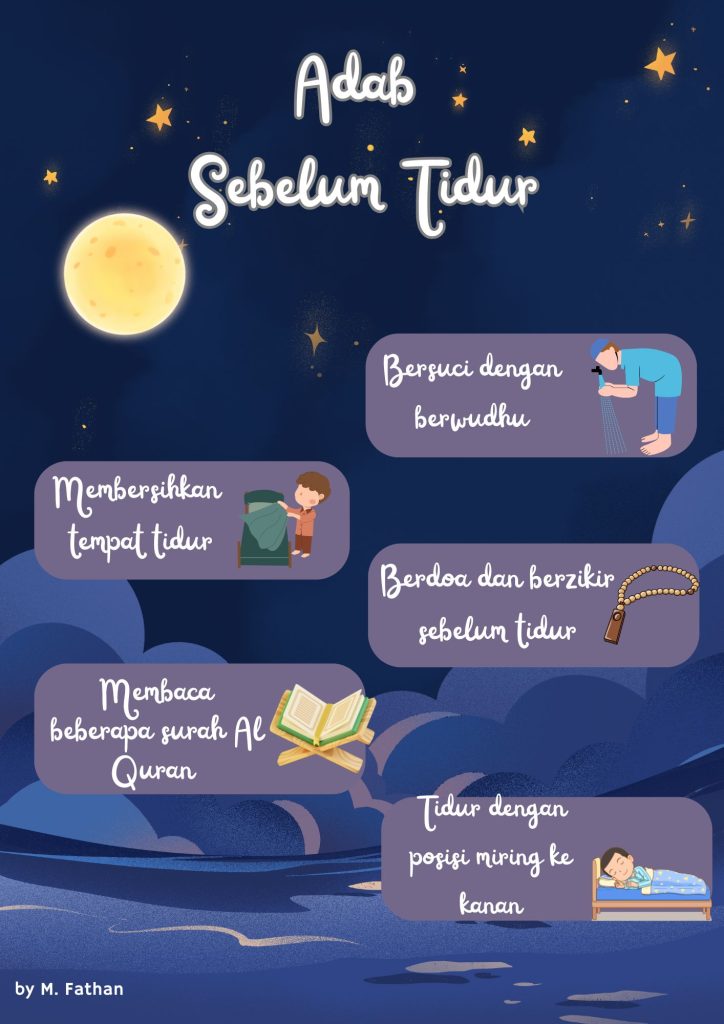
Etiquette Before Bed

🛏️ 1. Clean the Bed
Meaning: Maintaining cleanliness before sleeping is part of the sunnah of the Prophet ﷺ.

💧 2. Purify yourself by performing ablution
Meaning: Ablution before sleeping cleanses oneself physically and spiritually. Purpose: Maintaining purity and sleeping clean is a sunnah that brings rewards.

🤲 3. Pray and make dhikr before sleeping
Meaning: Remembering Allah before sleeping calms the heart and protects from disturbances. Goal: Close the day with gratitude and protection from Allah.

📖 4. Read several Surahs of the Koran
Meaning: Reading surahs such as Al-Ikhlas, Al-Falaq, and An-Nas is sunnah before sleeping.

😴 5. Sleep on your right side
Meaning: This sleeping position is a habit of the Prophet ﷺ and is recommended in Islam. Purpose: To imitate the sunnah and maintain body health while sleeping.

Categories
Project Diniyah

Rukun Rukun Wudhu

Rukun rukun wudhu

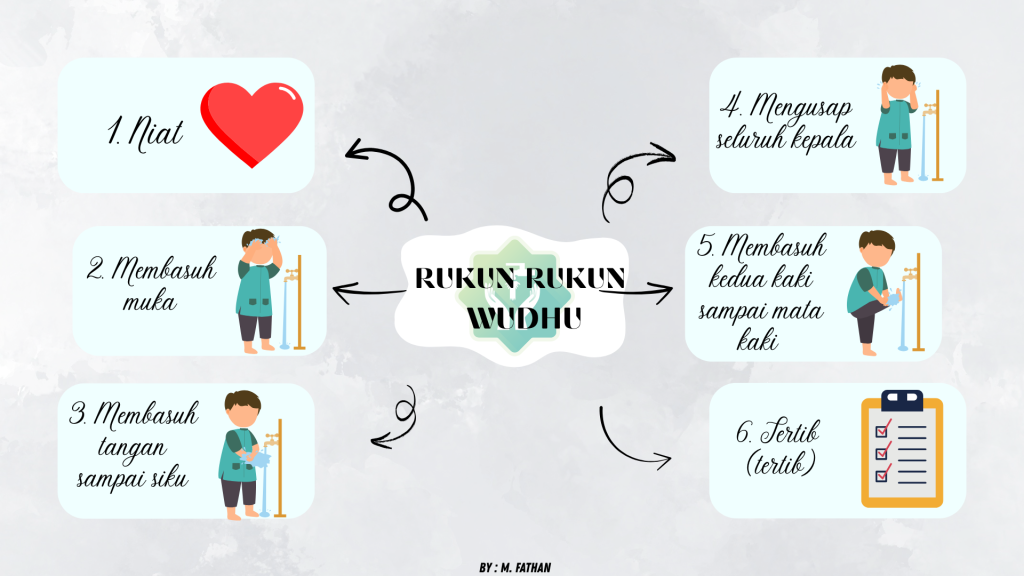
The pillars of ablution are divided into six parts. The first is intention, the second is washing the face, the third is washing the hands up to the elbows, the fourth is wiping the entire head, the fifth is washing both feet up to the ankles, and the sixth is orderly.
These are the pillars of ablution that must be performed when performing ablution. If any of the pillars is not performed or missed or not repeated, the prayer is invalid. So, the conclusion is that when we perform ablution, when we want to pray, we must perform ablution correctly and orderly.

Categories
Project Diniyah

Poster Akidah

Poster Akidah - Rukun Iman

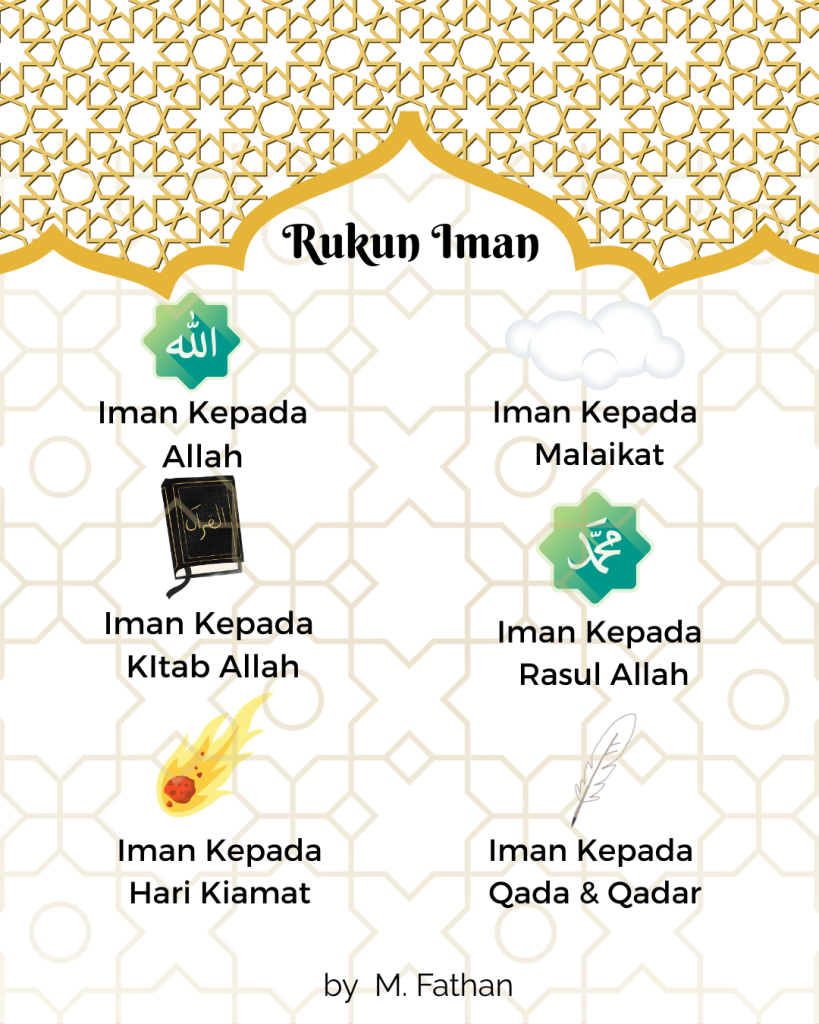
The Pillars of Faith are the six basic pillars of a Muslim’s faith, which include belief in Allah, His angels, His books, His messengers, the Day of Judgment, and destiny (qada and qadar), whether good or bad, which comes from Allah SWT. This term is derived from the word “rukun,” meaning pillar or foundation, and “iman,” meaning conviction or belief in the heart, which is also declared verbally and proven through bodily actions.